
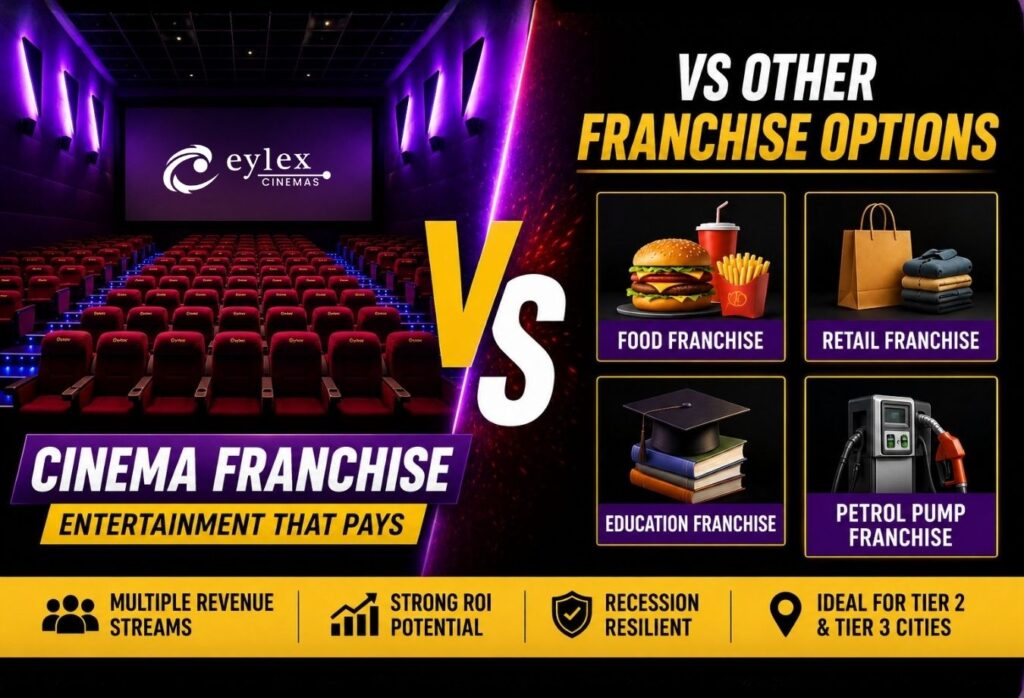
You’ve saved up some capital. You’re ready to invest in a franchise. Now you open a browser and suddenly you’re drowning — food franchises, retail chains, education centres, petrol pumps, and about forty different chai brands all promising you “the next big opportunity.”
The noise is real. But the clarity? Not so much.
So let’s cut through it. If you’re seriously comparing a cinema franchise vs other franchise options in India, here’s what the actual numbers and fundamentals look like — no hype, just honest math.
A Quick Comparison: Cinema vs The Usual Suspects
Before we go deep, here’s a side-by-side look at how different franchise categories stack up on the metrics that actually matter to you as an investor.
| Franchise Type | Avg. Setup Cost | Monthly Fixed Cost | Revenue Streams | Break-Even (Est.) | Recession Resilience |
|---|---|---|---|---|---|
| Cinema (e.g. Eylex) | ₹1.5–5 Cr | Moderate | Tickets, F&B, ads, events | 2–4 years | High |
| Food (QSR/Casual) | ₹20–80 L | High (perishables, staff) | Food & beverages only | 3–5 years | Medium |
| Retail (Apparel/FMCG) | ₹30 L–2 Cr | High (inventory) | Product sales | 3–6 years | Low–Medium |
| Education/Coaching | ₹10–50 L | Low–Moderate | Fees | 2–3 years | High |
Each of these has a real business case. But they don’t all have the same structural advantages. And that’s where cinema starts to pull ahead.
Why Eylex Cinema Franchises Are Structurally Different
Here’s the thing about a food franchise: you’re constantly fighting spoilage, fluctuating ingredient costs, and customers who can cook the same thing at home. Retail is battling e-commerce every single day. Education is competitive but geography-dependent.
A cinema franchise operates differently. Here’s why.
Captive Audience = Higher Spend Per Customer
Once someone buys a ticket and sits in that seat, they’re yours for two-plus hours. They buy popcorn, cold drinks, nachos — not because they have to, but because that’s just what you do at a movie.
Food & beverage sales in Indian multiplexes typically contribute 25–35% of total revenue. That’s revenue you don’t have to fight for.
Multiple Revenue Streams From One Location
A cinema earns from:
- Ticket sales
- Food & beverage counters
- On-screen advertising
- Brand activations
- Private screenings
- Live cricket screenings
- Stand-up comedy events
- Regional events & community shows
A food franchise mostly earns from one thing: food.
Entertainment Holds Up During Slowdowns
When budgets tighten, people cut holidays before they cut movies. A ₹200–400 ticket becomes affordable escapism.
That’s exactly why the entertainment sector often performs more steadily than other discretionary businesses during economic slowdowns.
The ROI Story: What 3–5 Years Can Actually Look Like
Let’s talk numbers.
Multiplex franchise ROI varies, but here’s a realistic picture for a well-run cinema in a Tier 2 or Tier 3 Indian city.
Assume a setup investment of around ₹2–3 crore for a 2–3 screen cinema.
At:
- 60–70% occupancy on weekends
- 30–40% occupancy on weekdays
A cinema can generate approximately ₹15–25 lakh in monthly gross revenue, depending on location, ticket pricing, local demand, and screen count.
After royalties, operations, staffing, utilities, and maintenance, a well-run unit can achieve 15–25% net margins.
That translates to:
- ₹25–50 lakh annual returns
- Capital recovery potential within 3–4 years
Of course, no franchise guarantees returns. But these are credible numbers when the business model and location are right.
This is the space Eylex Cinemas is focused on.
As an affordable cinema franchise model designed specifically for Tier 2 and Tier 3 Indian cities, Eylex lowers the entry barrier. You don’t need a metro city or luxury mall to build a profitable entertainment business.
Risks You Should Know Before Signing a Franchise Agreement
A balanced franchise investment comparison has to include the risks too.
1. Content Dependency
A weak Bollywood release cycle can affect occupancy for weeks. You don’t control film schedules or box office performance.
That’s why diversified programming matters:
- Regional films
- Live sports screenings
- OTT premieres
- Private events
2. High Upfront Investment
Projectors, sound systems, interiors, seating, HVAC, acoustic treatment — cinema infrastructure is capital intensive.
This isn’t a business you launch with ₹10 lakh.
3. Location Sensitivity
A cinema in the wrong catchment area will struggle regardless of branding.
Success depends heavily on:
- Population density
- Accessibility
- Competition nearby
- Local entertainment demand
4. Regulatory Complexity
Cinema businesses require:
- Fire NOCs
- Local municipal approvals
- Entertainment licences
- Safety compliance
The paperwork is more involved compared to many retail or food businesses.
What Separates a Good Cinema Franchise From a Bad One
Not all cinema franchise opportunities are equal. Here’s how smart investors evaluate them.
Strong Brand Backing
A recognised cinema brand drives footfall from day one. Unknown brands force you to spend aggressively on awareness.
Transparent Revenue Sharing
You should clearly understand:
- Ticket revenue splits
- Distributor percentages
- Royalty structures
- Marketing contributions
A good franchise partner keeps this transparent.
Operational Support
The best franchisors support you with:
- Content programming
- Staff training
- Technology systems
- Marketing campaigns
- Operational guidance
Eylex Cinemas, for example, offers operational support tailored for entrepreneurs who may be new to the cinema exhibition industry.
Scalability
A strong franchise model should allow you to:
- Add more screens later
- Expand into nearby cities
- Scale from one successful unit
Exit Clarity
Before signing, understand exactly what happens if you want to exit after 5–7 years.
A strong franchise agreement clearly defines buyback clauses, transfer terms, and renewal structures.
The Bottom Line

If you’re seriously comparing franchise opportunities in India, cinema deserves a place on your shortlist — not because it sounds glamorous, but because the economics can genuinely make sense.
Multiple revenue streams, strong customer retention, recession-resistant demand, and realistic 3–5 year return potential give cinema franchises a structural edge over many traditional franchise categories.
Eylex Cinemas is making this model more accessible for entrepreneurs in Tier 2 and Tier 3 India who want to enter the entertainment business without needing a PVR-sized budget.
If you’re looking for a differentiated, long-term franchise opportunity with real growth potential, it’s worth having a serious conversation.
Interested in Starting a Cinema Franchise?
Talk to the Eylex Cinemas team to understand:
- Investment requirements for your city
- Expected revenue potential
- Operational support structure
- Location feasibility
- Franchise onboarding process
Because your investment deserves more than guesswork.